





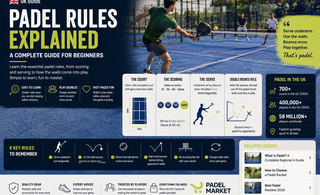
Padel is famously easy to pick up. If you can rally a few shots, you can play padel within minutes. Still, knowing the padel rules properly makes the game far more enjoyable and helps you avoid silly mistakes. This guide covers the basic padel rules, from the scoring system and the serve to how the glass walls come into play. It follows the Rules of Padel published by the International Padel Federation (FIP), in the version applicable from 1 January 2026.
How padel is played
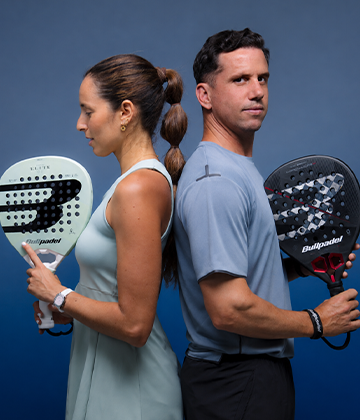
Padel is played on an enclosed court, almost always as doubles, with two players on each team and four players in total. A game looks a little like tennis, but the ball can rebound off the surrounding glass and mesh walls, which keeps rallies alive and makes long rallies the norm rather than the exception.
You use a solid, stringless padel racket and a ball that is very similar to a tennis ball but with slightly less pressure. The most important rule of all: the ball may bounce only once on your side before you return it.
The padel court
A padel court measures 20 metres by 10 metres (inside measurements), divided by a net. The net stands 88 cm high in the middle and 92 cm at the ends. On each side, the service line is 6.95 metres from the net, and a centre line splits that area into two service boxes.
The back walls are 4 metres high: the first 3 metres are wall (glass or solid) and the top metre is metal mesh. The side walls combine wall sections next to the back walls with metal mesh along the rest; on glass courts, each end has a glass panel 3 metres high and 4 metres long. Glass returns the ball predictably; the mesh usually kills it at an odd angle.
How to serve in padel
The serve must be underarm: when you strike it, the ball must be at or below waist height. You bounce the ball on the ground behind the service line on your own side, then hit it. At least one foot must stay on the ground, and you must not step on the service line or on the imaginary extension of the centre line.
You must serve diagonally, so the ball crosses the net and lands in the opponent's service box. The first serve of each game is taken from the right, and you then alternate sides point by point.
What makes a valid serve
For a valid serve, the ball has to land in the correct service box. After the bounce, it may touch the glass and still count. However, if the ball touches the metal mesh before its second bounce, the serve is a fault. It is also a fault if the ball hits the server or their partner.
As in tennis, the server has two attempts, so you get a first serve and a second serve. A serve that clips the net and lands in the correct service box, without then touching the mesh, is replayed. The receiver cannot volley the serve: the ball must bounce first.
Changing sides and padel serving order
At the start of each set, each team decides which player serves first, and that order stays the same for the whole set. The same player serves a whole game; next time it is that team's turn to serve, their partner serves. The receiving team also decides who receives first in the opening game, and that order is kept for the set.
Teams change ends after the first game, the third game and every odd game of the set to keep conditions fair. In a tie break, they change ends every six points.
The padel scoring system
Padel uses the same scoring system as tennis. Every point moves the score from 15 to 30 to 40, and the next point wins the game. What happens at 40-40 depends on the scoring format being used (see below).
Games, sets and matches
You need six games to win a set, with a margin of two games; at 5-5 you play on to 7-5. If a set reaches six games each, a tie break decides it: the first team to seven points, by two clear points, takes the set 7-6. Most matches are played as the best of three sets.
Deuce, the golden point and the Star Point
The FIP rules set out three ways to settle a game at 40-40:
- Advantage. The classic format: a team must win two points in a row to take the game.
- Star Point. Up to two advantages are played; if the game returns to 40-40 again, a single deciding point (the "Star Point") settles it.
- Golden point. No advantage at all: at 40-40, a single deciding point is played.
On a deciding point, the receiving team chooses which side receives the serve. None of the three is a universal rule: each competition or club sets the format, so check before you start.
Playing off the walls in padel
The walls are what make padel special. Your shot must land on the ground in the opponent's court first; after that bounce, the ball can hit the glass or the mesh and stay in play, and your opponents can return it after it rebounds.
You can use your own walls too. Once the ball has bounced on your side, you can let it come off your glass and still play your shot back over the net. You can also play the ball into your own glass wall so that it goes over the net, as long as it then lands in the opponent's court. What you cannot do is send it into your own metal mesh: if the ball touches the mesh or the ground on your side after you hit it, you lose the point.
The double bounce rule in padel
The ball is only allowed to bounce once on the ground before you return it. If the ball bounces twice on your side, your opponents win the point. This double bounce rule is at the heart of every rally.
When is the ball out in padel?
A shot is out if it hits the opponent's walls or mesh on the full, before bouncing on their ground. In other words, the ball must bounce first; it cannot fly straight into the opposing team's walls. A shot that fails to cross the net, or leaves the court without bouncing in the opponent's court, also loses the point.
Playing outside the court
If the ball bounces in your court and then leaves it, on courts that allow it you may run out of the court and return the ball before its second bounce. This is only allowed where the court meets the safety-area requirements of the rules. Where it is not allowed, a ball that leaves the court after a legal bounce wins the point for the player who hit it.
How a padel point is won or lost
You win the point when the opponent hits the ball out, lets it bounce twice, or fails to return it over the net. You lose the point if the ball touches your body or clothing, if you, your racket or anything you wear touches the net or the posts while the ball is in play, if you hit the ball before it has crossed the net, or if you or your partner hit it twice in a row.
Padel equipment: what the rules say
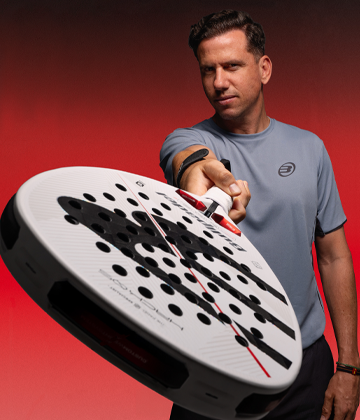
The padel racket has no strings: it is a perforated hitting surface, with a maximum length of 45.5 cm, a maximum width of 26 cm and a maximum thickness of 38 mm. It must have a safety cord, and wearing it around your wrist is mandatory.
The ball weighs between 56.0 and 59.4 grams and measures between 6.35 and 6.77 cm in diameter. Dropped from 2.54 metres, it must bounce between 135 and 145 cm, and its internal pressure ranges from 4.6 to 5.2 kg per 2.54 cm². To see what that means on court and which balls to choose, read our padel balls guide.
Padel rules versus tennis rules
Padel and tennis share a scoring system, but the differences are clear. Padel is played as doubles on a smaller, enclosed court, the serve is underarm, the racket has no strings and the walls are in play. These twists are exactly why so many tennis players are switching to padel.
Padel rules for beginners
If you are new to padel, focus on three things: let the ball bounce before you use the walls, keep your serve underarm and diagonal, and talk to your partner. Most beginners lose points by rushing the ball rather than by breaking any obscure rule.
Because the walls keep the ball in play, patience wins. Long rallies reward the team that stays calm, moves together and waits for the right ball to attack at the net. The right racket helps too: our guide on how to choose a padel racket for your level explains the criteria, a light, easy-handling option is the Adidas RX Series Light 2026, and you can compare our full range of padel rackets.
Who decides when there is a doubt?
In competition, the referee decides and their call on a rally is final. In friendly matches, the four players settle doubts between themselves; if nobody saw it clearly, the usual practice is to replay the point.
Frequently asked questions
Can you serve overarm in padel? No. The serve is always taken after a bounce, with the ball at or below waist height.
How many serves do you get? Two per point. If you miss both, it is a double fault and the point goes to your opponents.
Can the ball hit the mesh after bouncing? Yes, during a rally. On the serve, no: if it touches the mesh after bouncing in the service box, it is a fault.
Can you play the ball off your own wall? Yes, off the glass or wall on your side, as long as it then lands in the opponent's court. Not off your own metal mesh.
Can you volley the serve? No, the receiver must let the serve bounce first.
Is the golden point compulsory? No. The rules allow advantage, the Star Point and the golden point; each competition or club chooses which one to use.
How long does a padel match last? A best-of-three-sets match usually lasts between 60 and 90 minutes, depending on how close the games are and on the scoring format.
Can you touch the net once the point is over? Yes. The rule only applies while the ball is in play.