




lacoste soft 2026 (pala)
products.product.pickup_availability.unavailable
Description
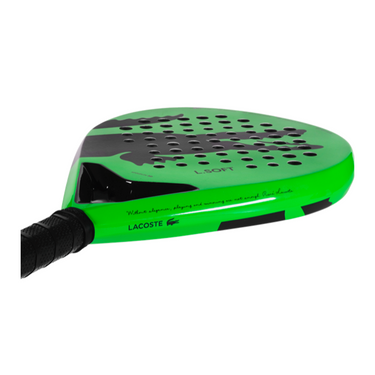
Lacoste L.Soft 2026: a diamond-shaped padel racket with a fibreglass face
The Lacoste L.Soft padel racket 2026 is the second of the two rackets, the L.MAX and the L.Soft, with which Lacoste entered padel, developed with Tecnifibre as part of a first collection that also includes footwear and clothing. The first is the L.MAX. This is the other one, and it stands apart thanks to a figure Lacoste does publish: 80% fibreglass and 20% graphite.
It's an unusual combination in a diamond-shaped padel racket, a shape usually associated with power and experienced players. That's what this page covers: what fibreglass does, what it costs you, and why a brand would pair a soft face with an attacking mould.
L.Soft specifications
- Brand: Lacoste, developed with Tecnifibre
- Model: L.SOFT, 2026 season, reference 16LACLSOF6
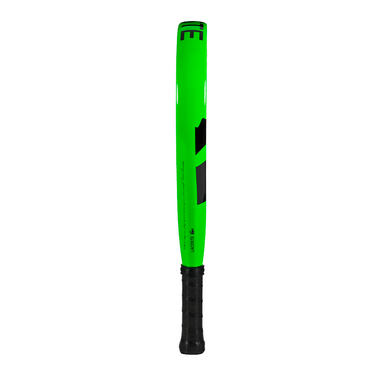
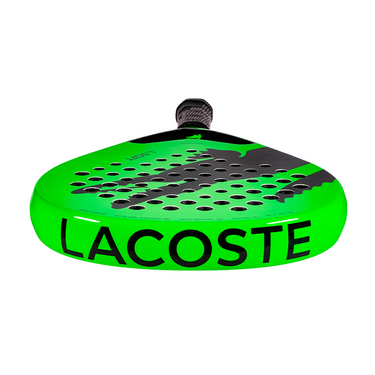
- Shape: diamond
- Stated composition: 80% fibreglass, 20% graphite
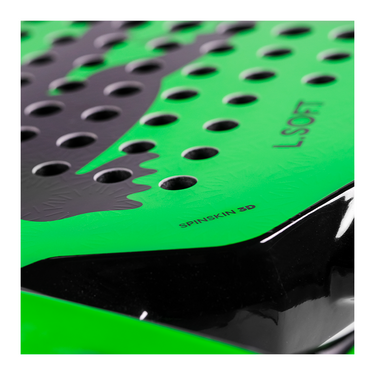
- Surface: rough, Spin Skin 3D, according to retailers
- Frame protection: Tecnifibre X-Top, according to retailers
- Weight according to retailers: 345 g
- Balance according to retailers: 26.5 cm
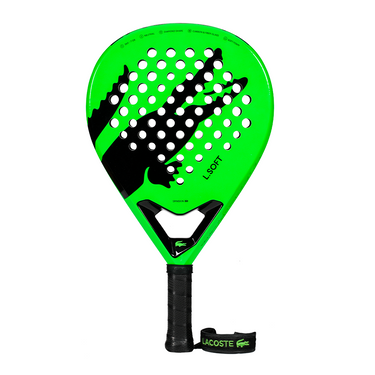
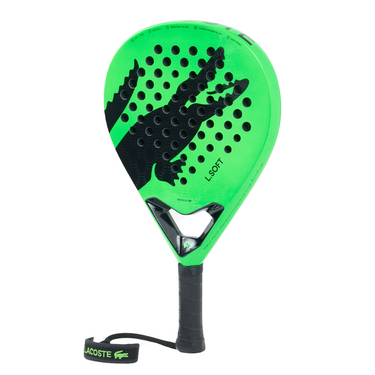
- Colour: green and black, with a large crocodile
- Includes: exclusive cover
What Lacoste says
Lacoste's website presents it as a racket designed for every player, from beginner to expert, developed with Tecnifibre, with a diamond shape for power, fibreglass and technologies for comfort, control and ease of play, and a large crocodile in the design. At launch, the specialist press positioned it as the collection's entry point, for improving players or those just starting out, with a larger sweet spot.
Lacoste doesn't publish the weight, balance, core or thickness on its spec sheet. The weight and balance figures above come from a shop, and we treat them as such.
Fibreglass versus carbon
Fibreglass is more flexible than carbon. In a racket, that means the face gives more when it receives the ball and sends it back with a trampoline effect: the ball comes off with less effort on slow and medium-paced shots, which make up most of the game for someone starting out. It's also more forgiving: off-centre hits are less punishing on the arm.
The trade-off is just as clear. At high speeds, a flexible face deforms more and the ball comes off less precisely; on a hard smash, a technically sound player will notice the racket soaking up some of the energy instead of returning it. And fibreglass is heavier than carbon for the same stiffness. That's why high-end rackets, like the L.MAX with its 18K carbon, go the other way.
Why a soft diamond?
It's the question anyone reading the spec sheet asks. A diamond shape puts the mass higher up, towards the head, which gives the shot momentum: with a short arm swing, the ball still comes off with force. A fibreglass face adds ball output. Together, they make a racket that tries to make up for what's missing early on: it makes hitting hard easy for someone who hasn't yet got the technique.
What you pay for that is manoeuvrability and control. A diamond with a 26.5 cm balance, if that retailer figure is correct, pulls towards the head: you notice it on quick volleys and in defence, and it tires the wrist more over long matches than a round racket. For a beginner looking for control and technique, a round racket is usually a better starting point. For someone starting out who enjoys attacking, this one makes sense.
X-Top and Spin Skin 3D
These are Tecnifibre technologies that the L.Soft shares with the L.MAX, and we explain them on its page: X-Top protects the frame from knocks and scrapes against the court, and Spin Skin 3D is the rough texture designed to increase grip on the ball for spin. What the L.Soft doesn't have, according to launch coverage, is the MAX's X-Speed.
L.Soft or L.MAX
The MAX has 18K carbon and weighs 360 g; the Soft has 80% fibreglass and weighs 345 g according to retailers. They're two rackets for two different players: the MAX for those who already hit hard and want precision; the Soft for those who want the racket to supply some of the power.
What you'll read in other shops
That it's a premium racket, that its foam core provides comfort, that its ultra-tough active fibres protect it from impacts and abrasion, that it has a carbon construction or that it weighs 350 or 360 grams. Lacoste publishes no core, no active fibres and no weight; and its composition is 80% fibreglass, not carbon. Several of those claims seem to come from the L.MAX or other Tecnifibre rackets. That's why we don't repeat them as facts.
Who is the L.Soft for?
- Beginners and improving players who want a racket that puts power into the shot.
- Anyone looking for a soft face that's easy on the arm on off-centre hits.
- Anyone who wants the Lacoste look on court, with the large crocodile.
- Not for anyone looking for precision on the hard smash or a manoeuvrable racket at the net: for that, a round racket or the L.MAX.
Frequently asked questions
What is it made of?
80% fibreglass and 20% graphite, according to Lacoste.
How much does it weigh?
The brand doesn't publish it. One shop gives 345 g.
Is it a padel racket for beginners?
Lacoste says it suits every level; launch coverage places it at beginner and improver level. Its diamond shape makes it more demanding to handle than a round racket.
How is it different from the L.MAX?
The face: fibreglass against 18K carbon.
Does it come with a cover?
Yes, an exclusive cover, according to Lacoste.
Conclusion
The Lacoste L.Soft 2026 pairs a diamond mould with an 80% fibreglass face: more ball output and more forgiveness, in exchange for precision and manoeuvrability. The entry-level racket in Lacoste and Tecnifibre's padel collection. You'll find it at Padel Market, in our padel rackets section.
Product details
Shipping and Returns
Shipping
No customs surprises: for the UK, all import duties and taxes are already included, so the price you see at checkout is exactly what you pay — nothing extra when your order arrives. Shipping is calculated by weight and destination; for example, a padel racket costs just £8. Delivery in 3–5 working days.
Returns
Had a problem with a product from padelmarket.com? Drop us a line through our Help Centre and we'll help you sort it out.
