




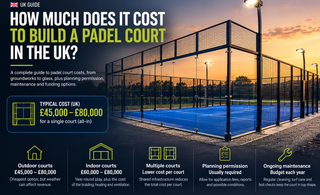
If you are weighing up a padel project, the first question is always the same: how much does it cost to build a padel court? In the UK the answer typically ranges from around £45,000 to £80,000 for a single court, but that range hides a lot of detail.
This guide gives a detailed breakdown of what drives the padel court cost, from groundworks to glass, plus planning permission, maintenance requirements and the funding available to eligible organisations. It is written for clubs, landowners and operators making informed decisions about a first court or a multi-court padel facility.
The short answer: padel court cost in the UK
The average cost for a new padel court is £55,000 to £80,000 once everything is accounted for.
Single outdoor padel courts typically cost between £45,000 and £80,000. Indoor courts generally cost £60,000 to £80,000 to build, before the indoor structure itself.
Those are capital cost figures for the court system installed. In practice the UK typically ranges between those figures, and the final price will vary depending on site conditions, court specification and how much civil engineering the ground needs.
Cost by court type
Single outdoor padel court
An outdoor court on reasonable ground is the cheapest way into the sport, at roughly £45,000 to £80,000. Outdoor padel courts suit clubs with existing tarmac or an existing foundation they can build on.
The trade-off is that outdoor courts face weather disruptions affecting revenue consistency, which matters in the UK climate.
Indoor padel courts
Indoor courts generally cost £60,000 to £80,000 for the court, and indoor courts require additional costs for heating and ventilation on top.
The upside is year round play. An indoor court books consistently through winter, which is when outdoor revenue falls away.
Multiple courts
Building multiple courts typically results in a lower cost per court due to shared infrastructure. Groundworks, drainage, lighting supply and access pathways are largely fixed costs, so spreading them across two or four courts brings the project cost per court down noticeably.
If you are considering a commercial operation rather than a single court project, model two courts minimum.
A detailed breakdown of the key components
A padel court is a kit of parts. Understanding the key components makes it far easier to compare quotes for court installation.
Site preparation and groundworks
Groundworks can account for a substantial share of total costs, and they are the single biggest source of cost differences between projects. Clearing, levelling and preparing the site is unavoidable.
If you already have a flat, load-bearing surface such as a disused tennis court, you may save a significant sum.
Foundation preparation
Foundation preparation is what the whole court system sits on. A reinforced concrete slab is the standard, engineered to take the load of the steel frames and glass walls without movement.
Skimping here is the most expensive mistake in padel court construction, because a settling foundation eventually shows up in the glass.
Drainage systems
Proper drainage systems are essential to prevent water pooling on the turf or destabilising the foundation. On a British site this is not optional.
Poor drainage shortens the life of the artificial surface and makes the court unplayable after heavy rain.
Steel frames
The steel framework for a padel court is usually made of galvanised or powder-coated structural steel. This is the skeleton that holds the glass and mesh.
Galvanising matters for long term durability outdoors, so check the specification rather than the headline price.
Tempered glass panels
Tempered glass panels form the back and part of the side walls. Tempered glass walls are used for durability and player safety, and they are one of the higher-value items in the build.
Panel thickness is a real cost variable: thicker glass costs more and plays better.
Mesh fencing
Mesh fencing encloses the remainder of the playing area. It is cheaper than glass, which is why court specification varies between a fully glazed court and a more standard mix of glass panels and mesh.
The playing surface
Padel courts use sand-dressed artificial turf for surfaces. The artificial grass is laid over the slab and dressed with silica sand, which is what gives padel its characteristic grip and slide.
Turf quality varies widely, and the artificial turf is the component players notice most.
Court nets and court lines
Court nets, posts and court lines are comparatively small items, but they are part of the court specification and should appear on any quote.
Lighting system
LED floodlights are commonly used for adequate court illumination. A lighting system is essential for any commercial facility in the UK, where a court without lights is unusable for much of the year after work.
Expect the LED lighting system to be a meaningful line item, and remember that local authorities may impose conditions on lighting and access.
Access control and ancillary equipment
Commercial venues increasingly add access control so players can book and enter without staff on site. Ancillary equipment such as benches, scoreboards and ball stores also belongs in the budget.
Access pathways
Access pathways, fencing and any landscaping around the court are easy to forget at quote stage and add to the overall cost.
Planning permission and building regulations
Do you need planning permission?
Planning permission is required for new outdoor padel courts in most cases, and indoor padel courts may also need planning approval depending on the structure.
Building regulations apply to any enclosed indoor structure, so factor both into the timeline.
Planning costs
Planning costs include application fees and surveys. Planning permission and environmental impact assessments can significantly add to pre-construction costs, particularly on sensitive sites.
Speak to your local council early. Local regulations vary, and an informal pre-application conversation is far cheaper than a refused application.
Conditions imposed by the local council
Local authorities may impose conditions on lighting and access, typically around operating hours, light spill onto neighbouring properties and noise. These conditions can materially affect the revenue model, so establish them before committing.
What makes the final price vary
Site conditions
Construction costs vary based on site conditions and specifications. Sloping, soft or contaminated ground pushes the civil engineering element up quickly, and the most complex projects can exceed the headline range entirely.
An existing foundation
An existing foundation in good condition is the single largest saving available. Converting a redundant tennis court is materially cheaper than building on a green field.
Court specification
A panoramic court with full glass sides costs more than a standard court using glass panels and mesh fencing. Turf grade and glass thickness move the number as well.
Indoor structure
If you are covering the court, the building is usually a larger cost than the court itself, whether that is a permanent structure or a tensioned fabric canopy.
Ongoing maintenance costs
Padel is relatively low maintenance compared with many sports facilities, but the running costs are not zero.
Annual maintenance
Annual maintenance costs for a padel court range from £400 to £500. That covers routine brushing, sand top-ups and general upkeep.
Turf replacement
Artificial turf should be replaced every 5 to 10 years, depending on usage and how well it has been maintained. This is the big periodic cost, so build a sinking fund from day one.
Cleaning the court surface
Regular cleaning of the court surface is essential for longevity. Brushing redistributes the sand, prevents compaction and keeps the surface playing as intended.
Lighting maintenance
Lighting maintenance costs should be included in the budget. LED units last a long time but are not permanent, and replacement at height needs access equipment.
Funding: the LTA Quick Access Loan Scheme
Padel is governed in Britain by the Lawn Tennis Association, and eligible organisations can access finance through it. The LTA Quick Access Loan Scheme offers loans from £25,000 to £250,000.
For many clubs this is the difference between a single court and a proper padel facility, so check eligibility before you finalise your funding plan.
Revenue generation: what a court can earn
Court hire
Court hire is the primary revenue stream. Peak evening and weekend slots do the heavy lifting, which is why lighting and, ideally, cover matter so much to the business case.
Other revenue streams
Coaching, leagues, social sessions and equipment sales all add revenue. Many venues also hire out rackets and sell balls at reception, which is a straightforward margin on an existing footfall.
If you are kitting out a new venue, our padel balls are available in boxes of 24 tubes, and the padel rackets range covers hire stock and retail.
Indoor or outdoor: which makes sense in the UK?
Outdoor courts have the lower upfront costs and are quicker to deliver. Indoor courts cost more but deliver year round play and far steadier bookings through a British winter.
Most commercial spaces that have made padel work at scale in the UK are covered, or at least partially covered. If the business case depends on winter revenue, budget for a structure.
A worked example: what a two-court project looks like
It helps to see the numbers assembled rather than listed. Take a club converting two disused tennis courts into two outdoor padel courts.
The existing foundation is sound, so site preparation is limited to resurfacing checks and drainage improvements rather than full groundworks. That alone removes a large share of the usual construction cost.
Two court systems, delivered and installed, sit at the lower end of the range because the steel frames, tempered glass panels and artificial turf are bought together. Shared LED lighting infrastructure and a single power supply cut the cost per court again.
Planning permission is still required, and the local council attaches conditions on floodlight hours. The club budgets for application fees, a lighting survey and a modest contribution to access pathways.
The result is a project cost per court meaningfully below what a standalone single court project would have cost on a green field site.
Timelines: how long does court installation take?
Once you have planning permission, the court installation itself is quick. A specialist team can typically assemble a single padel court in a week to ten days on a prepared base.
The long pole is everything before that. Planning determination commonly takes eight to thirteen weeks, and groundworks depend on weather and site conditions.
Realistically, allow three to six months from decision to first booking for a straightforward outdoor project, and longer for complex projects or anything involving an indoor structure.
Common mistakes to avoid
Underestimating groundworks. Most budget overruns come from the ground, not the court. Commission a site survey before you fix a budget.
Comparing quotes that are not like for like. One quote may include a full panoramic glass specification, LED lighting and drainage, another only the court system. Insist on a detailed breakdown.
Forgetting the running costs. Maintenance requirements, electricity for the lighting system and turf replacement all belong in the model from year one.
Skipping the planning conversation. Local regulations and building regulations differ between authorities, and discovering a constraint late is expensive.
Is a padel court a good investment?
Padel courts have relatively low maintenance requirements and a long asset life if the foundation and drainage are done properly, which is why so many tennis and racket clubs have added them.
The business case rests on utilisation. A court that books through the evenings and weekends year round behaves very differently from one that sits idle from November to March, which is the strongest argument for lighting and cover in the UK climate.
Run the numbers on realistic court hire rates for your area, add the secondary revenue streams, and compare that against the capital cost and the finance available before committing.
Frequently asked questions
How much does it cost to build a padel court in the UK? Typically £45,000 to £80,000 for a single outdoor court, and £60,000 to £80,000 for an indoor court before the building itself. The average new court works out at £55,000 to £80,000.
Is it cheaper to build more than one court? Yes. Building multiple courts results in a lower cost per court because groundworks, drainage, lighting supply and access are shared.
Do I need planning permission for a padel court? Usually yes for outdoor courts, and often for indoor ones too. Application fees, surveys and possible environmental assessments should be budgeted before construction.
What are the annual maintenance costs? Around £400 to £500 a year for routine upkeep, plus artificial turf replacement every 5 to 10 years and periodic lighting maintenance.
How long does artificial turf last? Five to ten years depending on usage and maintenance. Regular brushing and sand top-ups extend its life considerably.
Can I convert an old tennis court? Often yes, and it is one of the biggest savings available, because a sound existing foundation removes much of the groundworks cost.
Is there funding available? The LTA Quick Access Loan Scheme offers loans from £25,000 to £250,000 to eligible organisations.
Final thoughts
A realistic UK budget for a single padel court is £45,000 to £80,000, with indoor projects at the upper end and multi-court builds bringing the cost per court down.
The variables that matter most are site conditions, whether you have an existing foundation, and the court specification you choose. Get at least three quotes with a like-for-like court specification, confirm your planning position with the local council early, and budget for turf replacement from the start.
These figures are typical UK market ranges rather than a quotation, and any real project should be costed by a specialist installer against your own site.